Edge AI cameras · Updated October 2026
Parking lot cameras for occupancy, payment and security
How a camera with a vision model counts free spaces, ties parking time to a license plate and flags people in closed areas, and where to mount it in your lot.
Quick answers
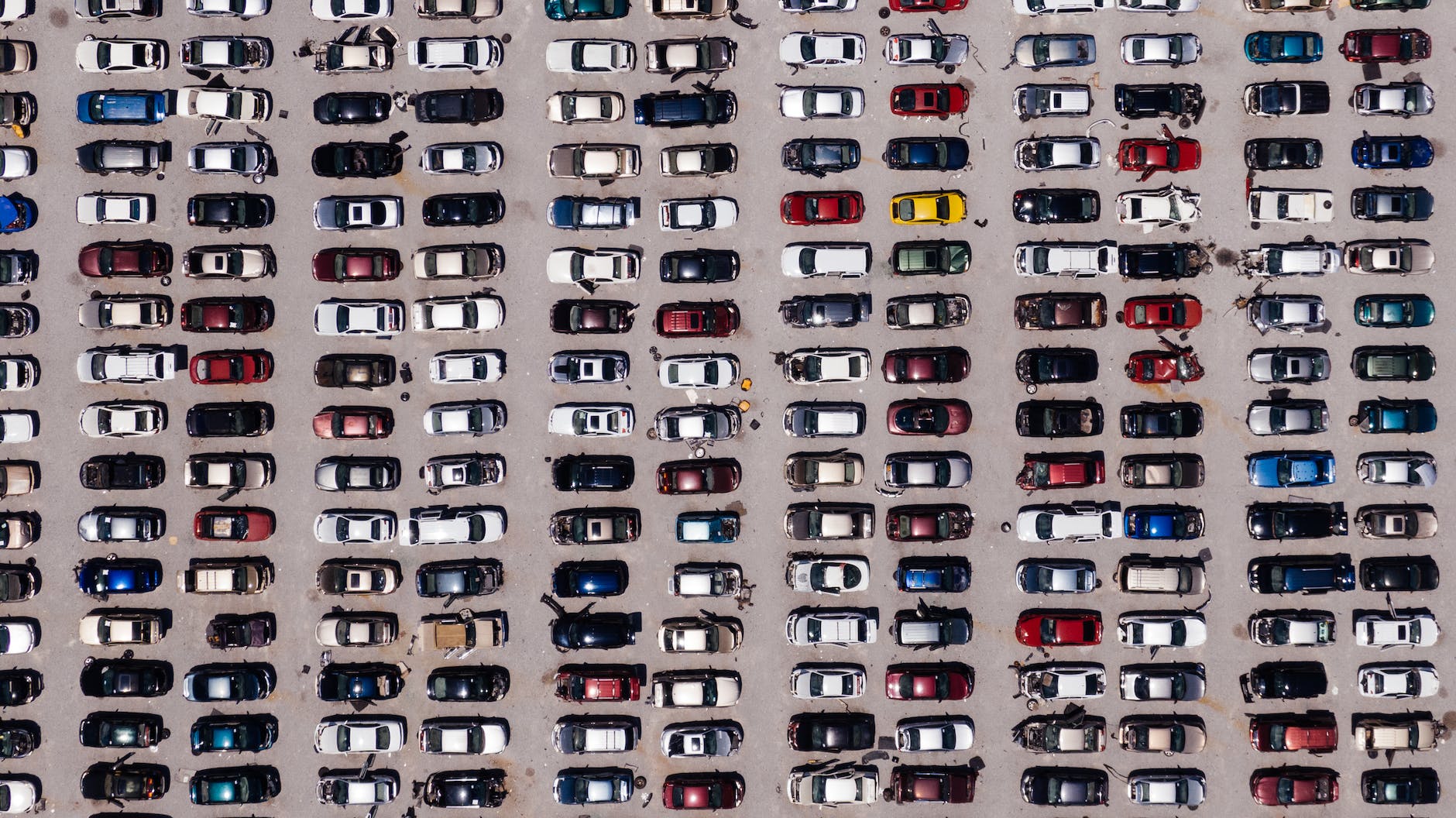
- How do parking lot cameras count free spaces? Either a camera over each row of bays marks every bay free or taken, or a camera at each gate counts cars in and out. Occupancy
- Can parking lot cameras read license plates? Yes, when the camera faces the lane at a gate where cars slow down; the plate then becomes the parking ticket. Payment
- Which AI cameras detect trespassers in parking lots? A camera that runs a person-and-vehicle model with zone and time rules, and sees at night with infrared. Security
- Cameras or in-ground bay sensors? Cameras mount on poles and walls that are already there; bay sensors mean work in every bay and a closed lot while it happens. Cameras vs sensors
How does a camera-based parking system work?
Cameras look at the lot, a vision model turns each frame into events, and an IoT platform stores the events and drives the signs, apps and payment system.
Cameras
Several cameras at different heights and angles cover the bays, the lanes and the gates. Together they record which bays are taken, which plates came in and how long each car stayed.
Vision model
An object-detection model finds vehicles and people; an optical character recognition (OCR) model reads plates. It runs on a server, or inside the camera so that only results go over the network.
IoT platform
The platform collects the events, keeps the history and feeds street displays, apps and websites that send drivers to a free space, including the accessible bays near the entrance.
Why use cameras instead of bay sensors?
Most parking occupancy systems put a sensor in or above every bay. In an existing lot that means cutting or drilling each bay, running power and data to it, and closing sections of the lot while the work is done.
A camera covers many bays from one pole or wall. Lots already have cameras and lighting poles, so a vision system often reuses the mounting points and the power that are already there. The same picture also answers questions a bay sensor cannot: which plate is in the bay, how long it has stayed, and whether a person is walking between the cars at 3 a.m.
The trade-off is the view. Trees, pillars and tall vans hide bays, and glare and snow change the picture. Garage counters have the same problem in a different form, as HowStuffWorks explains, so plan camera positions per row and test them in the dark and in bad weather.
How do cameras monitor parking lot occupancy?
The model counts vehicles and the gaps between them, so the system knows how many bays are free, which ones, and how that changes through the day.
Object detection finds each vehicle; plate reading adds who it is and how long it stayed. The counts go into a database, so the history shows busy hours and quiet ones and the operator can plan rates and staff around them. Researchers have built occupancy trackers on ordinary CCTV the same way.
Spot-based cameras
Mounted over the bays, they report each bay as free or taken in real time and can describe the car in it. Every bay has to stay in view, so a lot needs several cameras. This pays off in dense urban lots where space is short and drivers want to be sent to a specific bay.
Count-based cameras
Mounted at the entrances and exits, they count cars in and cars out and give a total for the lot or for each garage floor. One camera per lane is enough, which suits large lots. Many sites use both: count-based at the gates, spot-based on the busiest rows.
How do parking cameras handle payment and enforcement?
The camera at the gate reads the plate on the way in and on the way out. The plate is the ticket, and the tariff is worked out from the two times.
Pay by plate
No paper ticket, no meter and no QR code to scan. The driver pays against the plate in an app or at a kiosk, or the charge goes to an account linked to it.
Rates by time and demand
Because every stay is recorded, rates can change by hour, day or event, and the occupancy history shows when demand rises and falls.
Overstays and spare bays
Warnings and fines for cars that stay past their time go out without an inspector. Bays that sit empty show up in the data and can be rented out.
Can AI cameras detect trespassers in a parking lot?
Yes. The model finds people and vehicles, and rules on the platform decide which of them matter: where they are, at what time, and for how long.
Fences, barriers and guards cover part of a lot, and a guard cannot watch every row at once. A camera with a vision model watches its whole view all night and sends an alert only when a rule is met.
You draw the zones on the platform and set the rules, for example a person in a closed zone for longer than 10 seconds, a car in a restricted bay, or anyone at the fence after hours. The alert carries the time and the picture, which is the record the owner hands to the police. Catalytic converter theft from parked cars is a common reason lots add this.
At night the camera needs its own light. Infrared LEDs light the scene without a visible lamp, and a passive infrared (PIR) motion sensor can wake the camera so the model checks whether the moving thing is a person or a car.
Dwell in a closed zone
A person stays past the time limit in an area marked private.
Fence crossing
Someone enters across the perimeter line instead of the gate.
Wrong bay
A car parks in a reserved, accessible or EV bay it is not allowed to use.
After hours
Groups, racing or anyone on site once the lot has closed.
How do cameras help with EV charging bays?
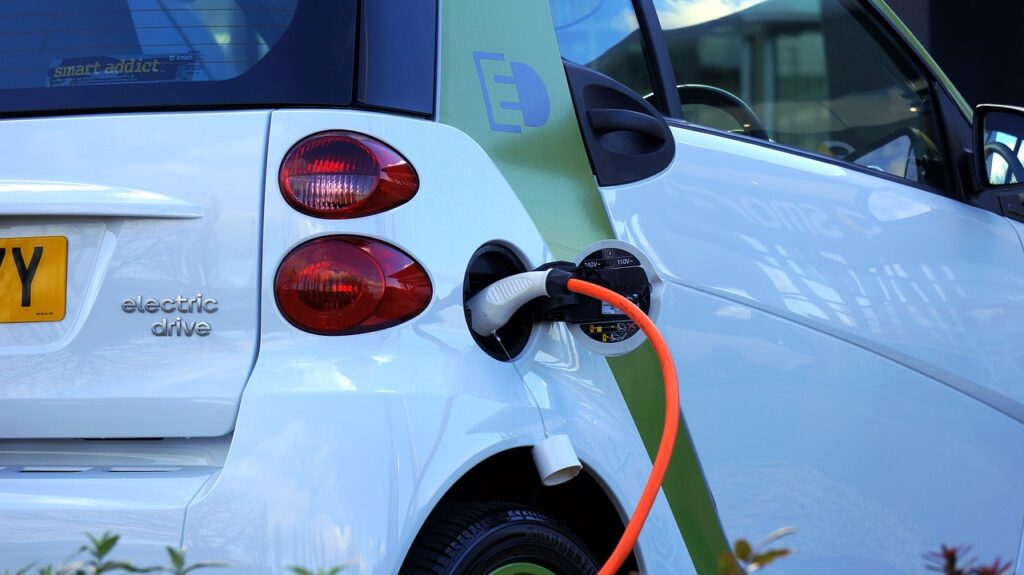
A charging bay is only useful when an electric car is in it and charging. A camera that reads plates and sees the bay can tell when a petrol car is blocking a charger, or when an EV has finished and stayed on.
The platform links those events to the chargers over a wired or wireless connection. Drivers then see which EV bays are free and get the shortest route to one, and the operator can charge for overstays the same way as in the rest of the lot.
Where this applies at Maxlab
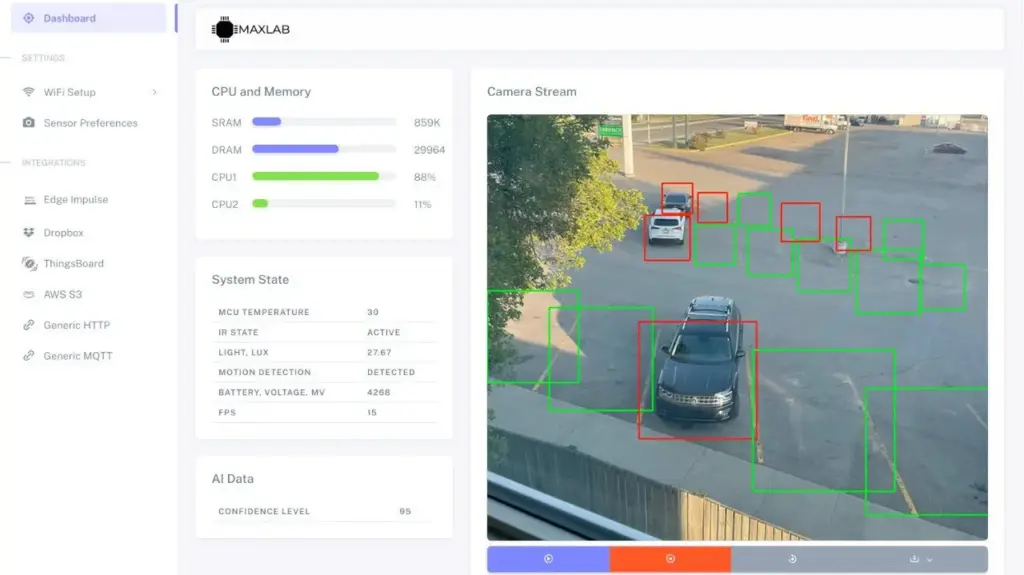
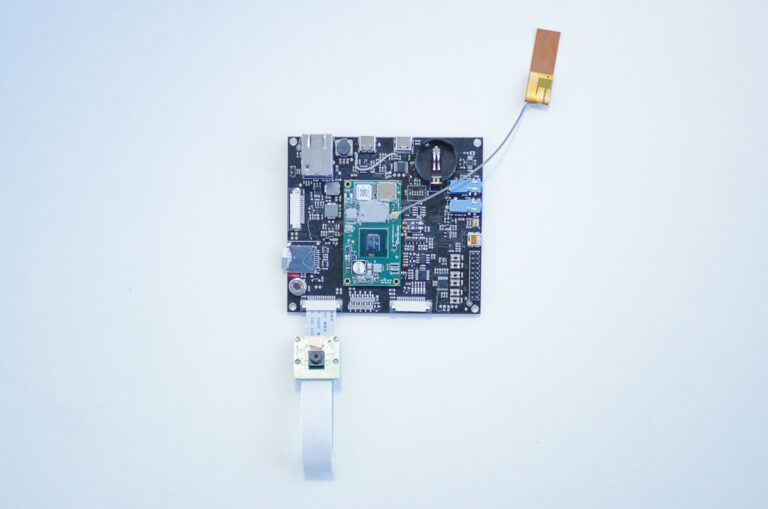
We build the camera side of systems like this. Tokay Pro is a Linux camera on the NXP i.MX 8M Plus that detects and tracks several objects per frame on its 2.3 TOPS accelerator and sends results instead of video. Its IR LEDs and PIR sensor let it watch a parking area at night, with the model deciding whether the movement is a person or a vehicle. For a pole with no power, Tokay Lite runs detection on an ESP32-S3, wakes on motion and lights the scene with infrared to about 10 m; see ESP32-CAM vs Tokay Lite for how it differs from a hobby board.
The events go to your own system over MQTT or HTTP, or to Rainforest IoT, the device platform we host, which shows them on dashboards and pushes firmware updates to every camera. The solar roof camera on our work page is built on the Tokay Lite platform and shipped 9,500 units. Mounts, enclosures, the plate or occupancy model and the integration are part of our hardware and firmware services.
- Tokay Pro
- i.MX 8M Plus, 2.3 TOPS, up to three sensors, by quote
- Tokay Lite
- ESP32-S3, PIR wake, IR to about 10 m, on Mouser
- Rainforest IoT
- Hosted dashboards and over-the-air updates
- Shipped on Tokay Lite
- 9,500 solar roof cameras
Planning cameras for a parking lot
Tell us how many bays and gates the lot has, what power is at the poles and what the system has to report. We reply within 24 hours.
Or email hi@maxlab.io or book a 30-minute call.
Common questions
Do parking lots have cameras?
Most commercial lots and garages already have security cameras. If a camera's view covers the bays or the gates, its picture can feed a vision model for occupancy or plate reading; if not, a few new cameras on the existing poles fill the gaps.
Can parking lot cameras see license plates?
A camera placed for the whole lot usually sees plates too small or at too steep an angle to read. Plate reading works at the entrances and exits, where a camera faces the lane and cars slow down. That is why pay-by-plate systems put their cameras at the gates.
How good are parking lot cameras at counting free spaces?
It depends on the view more than the camera. Bays hidden by pillars, trees or tall vans, glare and snow all cause misses. Mount spot-based cameras high with a clear line along each row, test at night and in bad weather, and use gate counts as a cross-check.
What is the difference between a parking camera and a parking occupancy sensor?
A bay sensor reports one bay as free or taken and has to be installed in or above every bay. A camera reports many bays from one mounting point and can also read the plate, measure how long the car stayed and see people in the lot.
Is camera checkout better than a QR code or pay-by-plate app?
With camera checkout the plate is read on the way in and out, so the driver does nothing at the gate. A QR code needs the driver to scan and pay. Many lots use the camera to read the plate and let the driver pay against it in an app or at a kiosk.
Is there open-source software for parking management?
The vision side can be built on open tools such as OpenCV and TensorFlow Lite, which run on Tokay Pro. The camera then sends events over MQTT or HTTP to whatever system you choose, including Rainforest IoT, the platform we host.
Can a parking lot camera run on solar or battery power?
Yes, for event-based jobs. Tokay Lite sleeps until its PIR sensor or a timer wakes it, runs detection on the board, sends the result and sleeps again, so it suits poles without mains power. Continuous plate reading at a busy gate needs a powered camera.
Do parking lot cameras work at night?
They do if they bring their own light. Infrared LEDs light the scene without a visible lamp; Tokay Lite's reach to about 10 m. For wide rows, mount the camera where the lot lighting already falls on the bays.
Should a parking camera process video on the device or in the cloud?
On the device when bandwidth or privacy matters: the camera sends a count, a plate or an alert instead of a video stream. In the cloud or on a server when you already have many cameras streaming to one place and the network can carry it.