Edge AI cameras · Updated October 2026
How AI cameras are used in manufacturing
An AI camera for manufacturing takes a picture, runs a trained model on it and reports a result: a part's position, a pass or fail, a machine's run time, a code read off a box. This guide follows one product through the plant and shows the nine jobs a camera does on the way.
Quick answers
- What are AI cameras used for in manufacturing? Finding and measuring parts during assembly, catching defects and watching machines and people during production, and checking packages and reading codes before shipping. More
- A line camera spots cracked phone screens before packing. Which form of AI is that? Computer vision, also called machine vision: a model trained on images of good and cracked screens classifies each phone from the camera frame. More
- How do AI cameras monitor equipment usage in factories? The camera watches a machine or work cell and logs when it runs, waits or is being loaded, then sends those times as events. More
- Does an AI camera need a PC? Not if the model runs on the camera. An edge AI camera processes each frame itself and sends only the result over Wi-Fi, Ethernet or USB. More
- 9 jobsan AI camera does along one line, in three stages
- $20,000a minute: the cost of downtime on an automotive line, as reported by Control Engineering
- 3 sensorsat once on Tokay Pro: visible, thermal and spectral from one camera
- 2.3 TOPSof neural-network compute inside Tokay Pro, so no PC sits at the line
What are AI cameras used for in manufacturing?
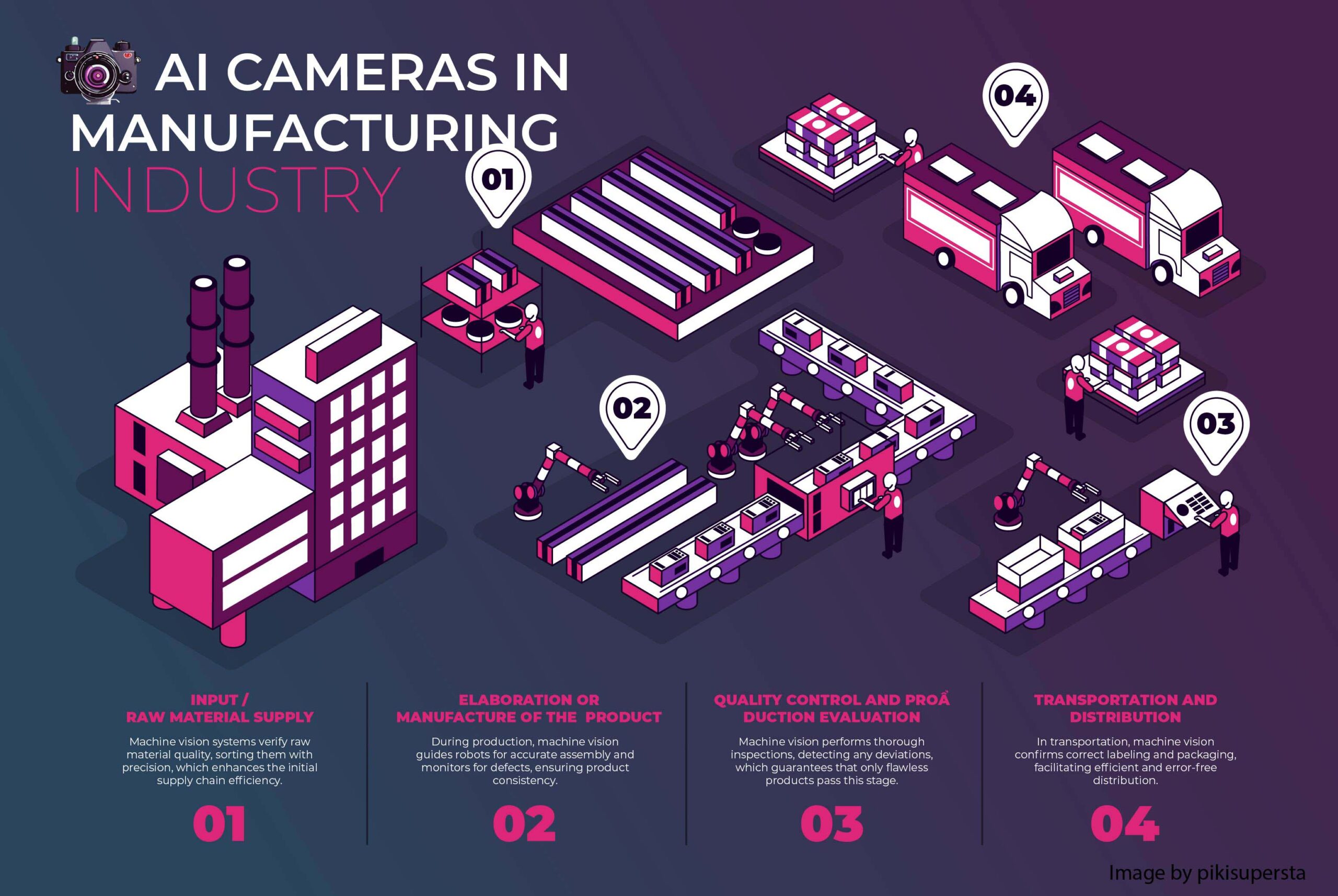
Call the product Product X. It passes through three stages on its way to a customer, and a camera has three jobs in each. The diagram shows what the camera reports at every step.
| Assembly | Quality | Delivery |
|---|---|---|
| Object detection | Defect detection | Packing and labeling |
| Measurement | Equipment monitoring and predictive maintenance | Track and trace |
| Guidance | Safety and compliance | Rolling out to more lines |
Which cameras do factories use?
Four kinds of industrial camera cover most lines. What makes any of them an AI camera is where the model runs: on a PC beside the line, or inside the camera itself.
GigE (Gigabit Ethernet)
Sends images quickly over long Ethernet cable runs, so the camera can sit far from the computer that processes its frames.
Industrial USB
Plugs into a computer by USB and gives high-resolution, low-noise images. These cameras are often very small, which keeps them cheap and easy to mount.
Overhead
Mounted above the floor to see the whole hall. Used to map and follow people, products and machines as they move.
Line scan
Captures one row of pixels at a time from an object moving past, on a conveyor for example, and stitches the rows into an image.
A classic vision system streams frames to a PC that runs the software. An edge AI camera carries its own processor and neural-network accelerator, so the model runs where the picture is taken. Only the result leaves the camera, so there is no PC at the line and the network carries events instead of video. The machine vision camera guide covers the wider field outside the factory.
How AI cameras help with assembly
Product X first has to be put together. On the floor, AI cameras are often built into industrial robots, which lets the robot find, measure and place parts without a person lining each one up.
Parts come in different sizes and shapes, and they move between work areas. The camera gives the robot the part's type and position on every cycle.
Object detection
The camera finds each part by its coordinates or by its position relative to an operator. Where parts are mixed with other items, the system separates them using structured light, laser projection or time-of-flight imaging, which measures how long a light pulse takes to bounce back. Robots can then count, pick and sort parts, and the same counts keep stock figures current.
Measurement
From 3D images the system works out a part's length, width, volume and surface area, so only parts in tolerance reach the next station. Cameras time the line too: how long a cycle takes and when the next one can start. Those times can go to an IoT dashboard to build a process model of the line.
Guidance
Welding, painting and repeat assembly are often given to robots, especially where the work is dangerous for people. The camera tells the robot where the seam or the surface is on each piece, so the arm follows the part in front of it rather than a fixed path.
How AI cameras check quality and watch equipment
Random sampling checks a few units and trusts the rest. A camera on the line can look at every unit, and it can also watch the machines that make them.
Defects, machine wear and unsafe behaviour all show in the picture when the camera is placed, lit and trained for them.
Defect detection
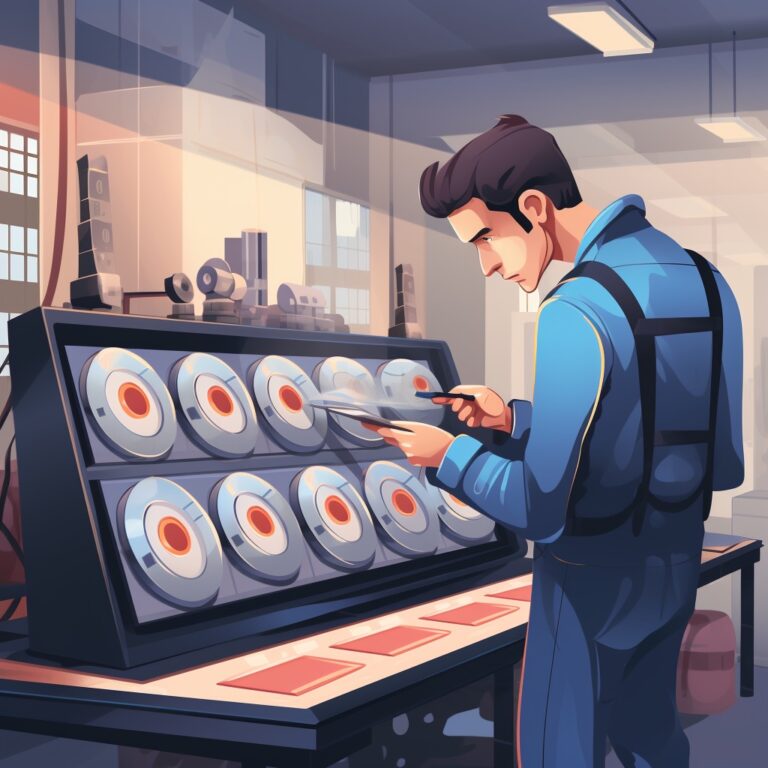
A model trained on pictures of good and faulty units marks each one pass or fail, and the system ties the result to a serial number, a source and a time. A cracked phone screen caught before packing is a common example. Hyperspectral imaging extends this beyond visible light, to flaws that show only at other wavelengths. Faulty units are pulled off the line or flagged for an inspector.
Equipment monitoring and predictive maintenance
Pointed at a machine, the camera logs how long the tool runs, how long it waits and when it is being loaded. That is the usage figure a plant manager asks for. With thermal or multispectral sensors and a trained model, the same camera can flag overheating, leaks, corrosion or deformation and alert the crew before a breakdown. On a car line, Control Engineering reports downtime can cost $20,000 a minute.
How AI cameras keep a factory floor safe
Cameras that see the whole floor can route autonomous vehicles around people and objects, and machine vision can detect a fire in its early stage. After an accident, the system can raise the alarm, show staff where to go and stop nearby processes.
The same overhead view checks site rules. Is everyone in the zone wearing a helmet? Is anyone inside a restricted area while a machine cycles? Pattern recognition answers both and alerts a supervisor. For perimeter and parking-area security, see our post on cameras for smart parking lots.
How AI cameras check packaging and trace shipments
Product X now has to leave the plant in one piece and be traceable once it has gone. Cameras check the package, read every code on it and hand the records to the next plant that builds the same product.
Packing and labeling
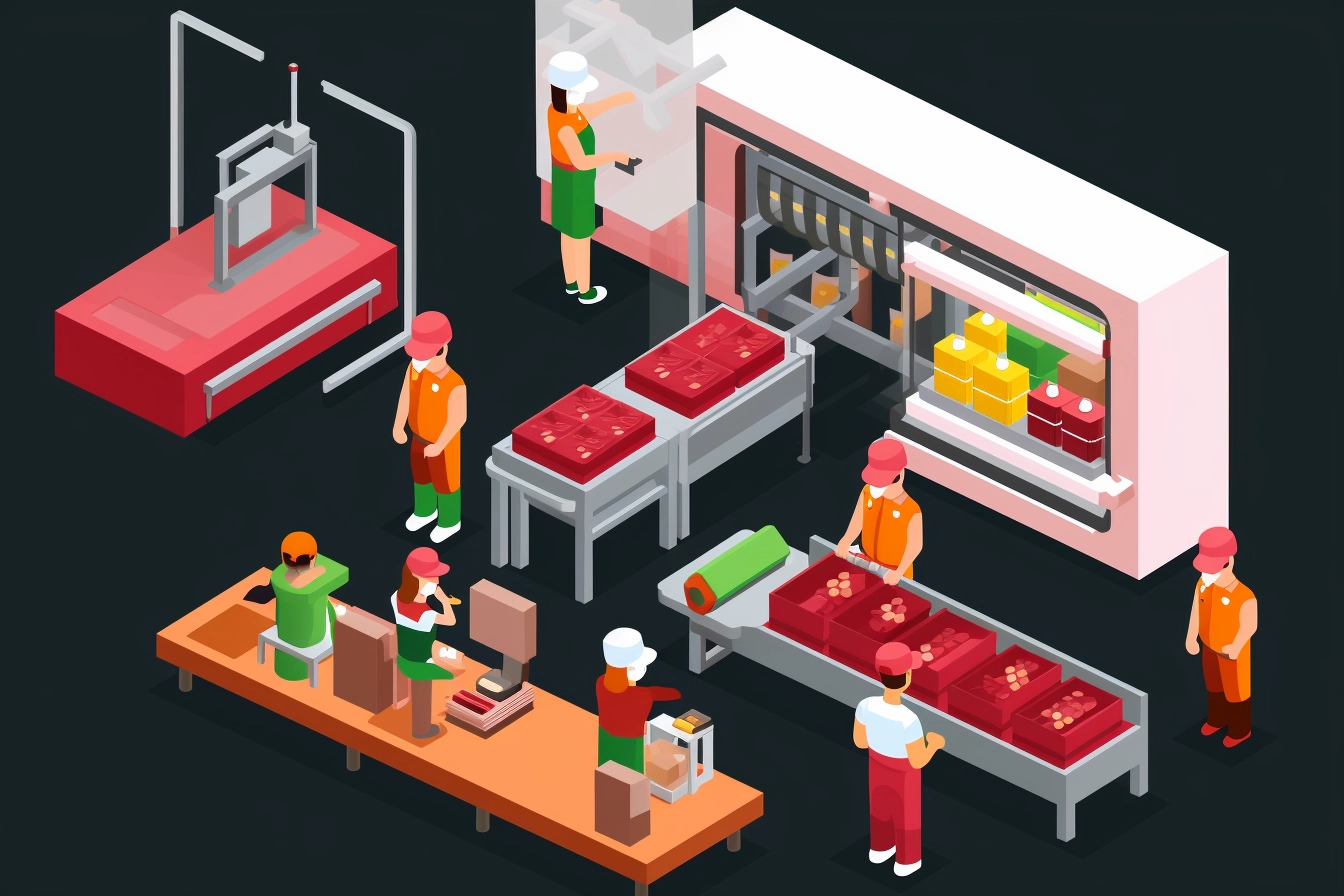
Cameras guide the machines that fill boxes, bottles, cartons and pallets, then inspect the result for tears, open flaps, loose caps and the wrong unit count. A case that fails is stopped before it leaves the plant.
Track and trace
Optical character recognition reads printed labels, serial numbers, barcodes, QR codes and dates. The reads go to a database that shows where each unit is, and units with unreadable codes are diverted. Food and pharmaceutical makers rely on this to meet rules on ingredients, recipients and expiry dates.
Rolling out to more lines
Once a camera setup works on one line, the model and the data behind it (part properties, common defects, good working conditions) can be copied to the next line or plant. The second installation starts from a trained model instead of a blank one.
What should you check before buying an AI camera for a line?
Four things decide whether an industrial AI camera works on your line.
Accuracy you can test
Where very high accuracy matters, the model, the lens and the lighting decide the result as much as the camera does. Ask for the model to be tested on your own parts under your own lighting before anyone quotes an accuracy figure.
Processing in the camera
A camera with its own neural-network accelerator runs the model without an external PC. That means one less computer to maintain at each station and only results on the network.
The right sensors
Pharma and food checks often need more than visible light. A camera with several sensor ports can check a blister pack for a missing tablet and the seal for heat at the same time.
How results get out
Decide where the events, counts and clips go: your MES or SCADA system, a cloud dashboard, or a local store. The camera should speak a standard protocol such as MQTT or HTTP so it fits the systems you already run.
Where this applies at Maxlab
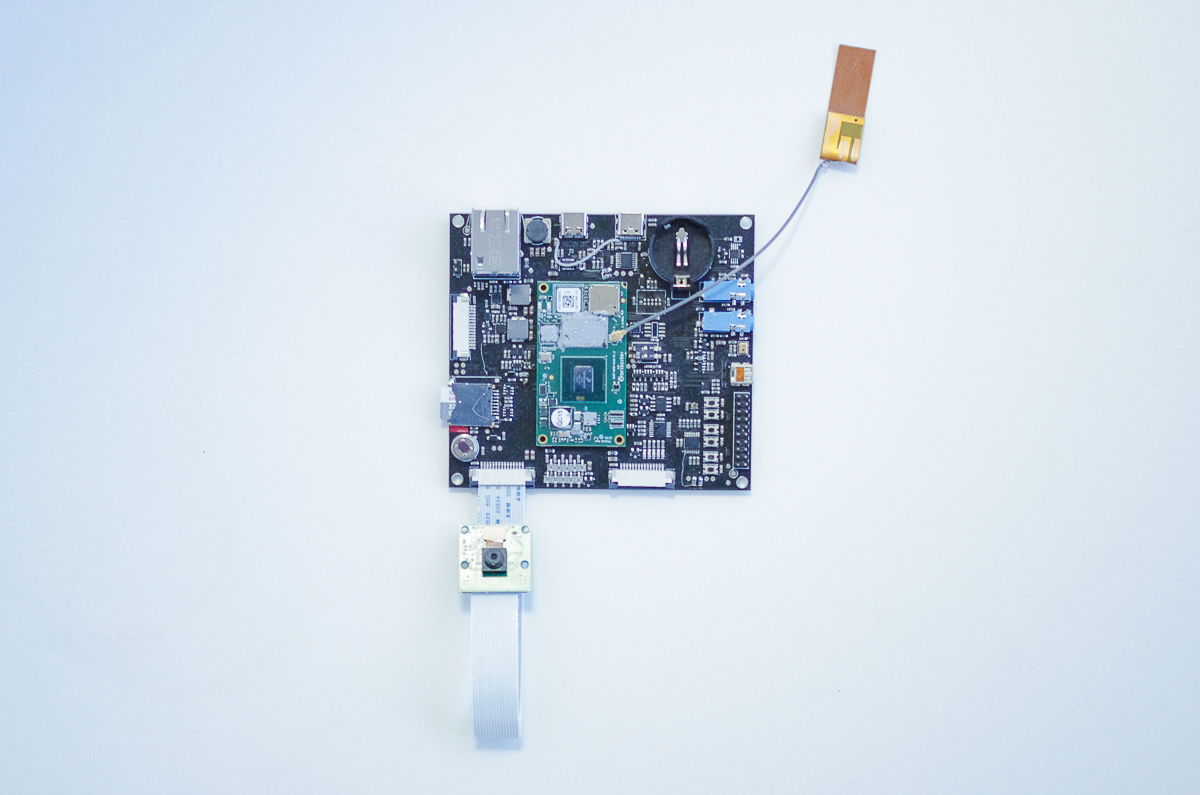
For production lines we build on Tokay Pro, a Linux camera on the NXP i.MX 8M Plus. Its 2.3 TOPS neural processing unit runs detection and tracking inside the camera, and three MIPI-CSI ports let a visible, thermal and spectral sensor work side by side. It sends events, counts or short clips over Wi-Fi, USB-C or to an SD card, directly to your system or through Rainforest IoT. Tokay Pro is supplied by quote, as a camera or as the base for your own product.
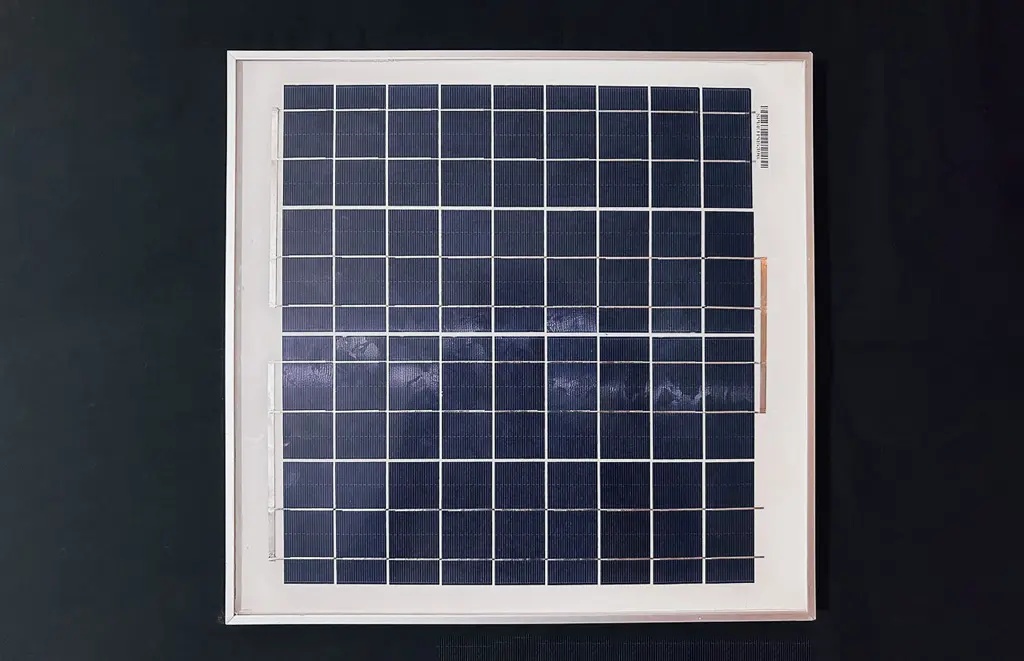
Battery and solar jobs, such as a camera on a roof or a fence with no power, go on Tokay Lite. The solar roof camera we built on it shipped 9,500 units. When a line needs a camera of its own, with the mount, lighting, model and enclosure designed together, that is our hardware and firmware service.
- Line camera
- Tokay Pro, i.MX 8M Plus, 2.3 TOPS NPU, Linux
- Sensors at once
- Up to 3: visible 8 MP, thermal, spectral
- Supply
- By quote, single unit or batch
- Shipped on our cameras
- 9,500 solar roof cameras on Tokay Lite
Put a camera on your line
Tell us what the camera has to find, how fast the line runs and how many stations you need. We reply within 24 hours.
Or email hi@maxlab.io or book a 30-minute call.
Common questions
What does AI camera mean?
AI stands for artificial intelligence. An AI camera is a camera that runs a trained model on its images and reports what it found, such as a count, a defect or a person in a restricted zone, instead of only recording video. When the model runs inside the camera it is called an edge AI camera.
What is a smart manufacturing camera?
An industrial camera that sends results to the plant's systems rather than pictures to a screen. On a line it finds and measures parts, inspects each unit, logs machine run time and reads codes on packages. The results go to the line controller, a database or a dashboard.
Cameras on a factory line identify cracked smartphone screens before the phones are packaged. Which form of AI does this represent?
Computer vision. A model trained on images of good and cracked screens looks at each phone in the camera frame and decides pass or fail, and the failed phones are pulled before packing. In manufacturing this is usually called machine vision or automated visual inspection.
How do AI cameras monitor equipment usage in factories?
The camera is aimed at a machine or work cell and trained to recognise its states: running, idle, being loaded, stopped. It records how long each state lasts and sends the times as events, which gives the utilisation figure for each machine without wiring into its controller. With a thermal sensor it can also flag a machine that runs hot.
Which AI cameras can be used where extremely high accuracy is required?
Accuracy comes from the whole setup: the sensor resolution, the lens, the lighting and the model trained on your parts. Pick a camera with enough resolution for the smallest defect you need to see, and test the model on your own parts before you accept an accuracy figure. Tokay Pro uses an 8 MP sensor as standard and takes a thermal or spectral sensor beside it.
Which AI cameras are suitable for pharma?
Pharma lines need inspection and traceability: a check for a missing tablet or a bad seal, and a reliable read of lot codes, serial numbers and expiry dates. A camera with more than one sensor port can check the blister with a visible sensor and the seal with a thermal one at the same time. Track-and-trace reads go to a database for the regulatory record.
Do AI cameras need Wi-Fi?
They need some link to send their results, but it does not have to be Wi-Fi. GigE cameras use Ethernet, industrial USB cameras plug into a computer, and Tokay Pro sends over Wi-Fi, over USB-C or to its SD card. Because an edge AI camera sends results rather than video, the link can be modest.
Can an AI camera process images without an external PC?
Yes, if it has its own processor and neural-network accelerator. Tokay Pro runs the model on the 2.3 TOPS NPU of its NXP i.MX 8M Plus and sends only events, counts or short clips.
How much does an AI camera for manufacturing cost?
It depends on the number of stations, the sensors each one needs and how much custom work goes into mounts, lighting, enclosure and the model. Tokay Pro is priced by quote for a single evaluation unit or a batch. Budgets for custom development are in our cost and timeline guide.
Can we get an OEM AI camera built into our own machine?
Yes. Tokay Pro can be supplied as the base for your own product, with the sensors, enclosure, power input and firmware specified for your machine. Our hardware and firmware service covers the design work, and the solar roof camera is one camera product we took to 9,500 units.
What is the difference between an AI camera and a machine vision camera?
A machine vision camera is any camera used to make an automatic decision from an image. Older systems run fixed rules on a PC. An AI camera runs a trained model, which copes better with parts that vary in shape, colour or position. Our machine vision camera guide covers uses outside the factory.